
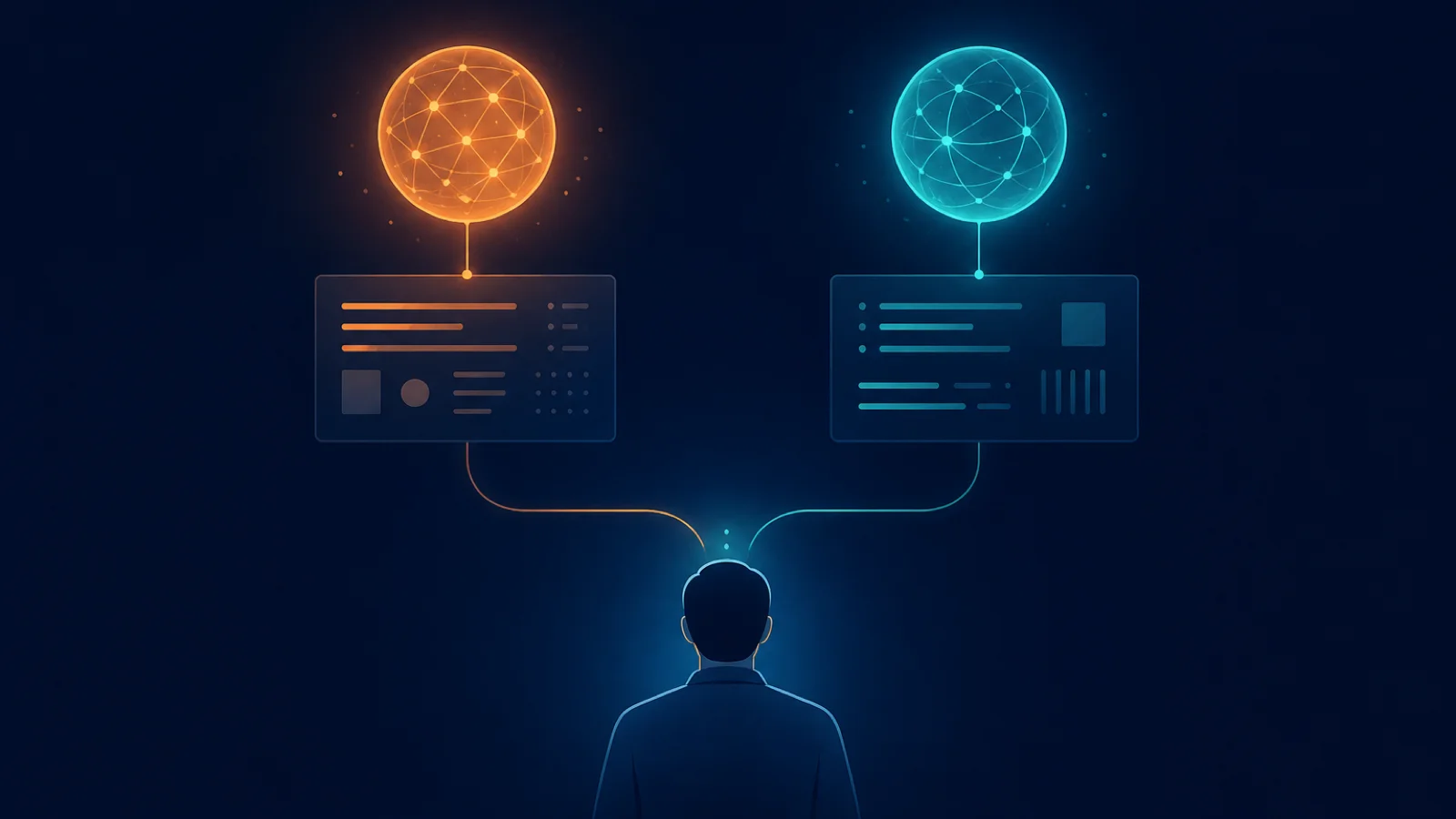
Should you run Claude Code and Codex together?
If you already pay for both Claude and ChatGPT, yes — running Claude Code and Codex on the same project is worth an afternoon of setup. As of July 2026 there are three patterns that work reliably:
| What you want | First choice |
|---|---|
| Hand finished work to an independent reviewer | OpenAI's official Codex plugin for Claude Code |
| Run independent tasks in parallel in one repo | One agent per git worktree |
| Keep track of many tasks across both agents | A multi-agent manager (free options first) |
One honest caveat before anything else: if a single agent already covers everything you do, you don't need a second subscription. This guide is for developers who have both, or who have a concrete reason — usually independent review — to add the second one.
Why use both instead of picking one
The "which is better" question doesn't have a stable answer, and that's exactly why the combination is useful.
We tested this directly. On July 26, 2026, we gave Claude Code and Codex CLI the same task set on the same Mac, from the same baseline commit, with the same acceptance criteria and external MCP servers disabled. Both implemented a multi-file feature and passed every test — including three hidden tests neither agent ever saw. In a review task with five deliberately planted bugs, both found all five. Neither product "won."
What two vendors give you is not a winner. It's an independent second opinion: a reviewer that doesn't share the implementer's context, assumptions, or blind spots. When one agent reviews its own work, it tends to defend it. Don't let an agent grade its own homework — hand the diff to the other vendor's agent instead.
In our isolated cross-review test, each agent reviewed the other's implementation with no access to the author's conversation. Codex confirmed Claude Code's diff introduced no regressions. Claude Code confirmed the same for Codex — and also flagged three items that turned out to be pre-existing baseline issues outside the diff, a useful reminder that reviewer output still needs human triage.
Still deciding which one to subscribe to first? That's a different question than this guide answers, but the short version from our testing: start with Claude Code if your style is interactive — steering work in a conversation and course-correcting as you go. Start with Codex if your style is delegation — handing over a well-defined task and reviewing the result. Add the second one when you want independent review, not more of the same.
What you need before you start
Facts below were checked against official pricing and docs pages on July 31, 2026. Both companies changed pricing and packaging earlier in 2026, so re-check before you subscribe.
| Agent | Included in | Where it runs |
|---|---|---|
| Claude Code | Claude Pro ($20/mo) and Max ($100/$200 tiers) | Terminal CLI; Claude Desktop app on macOS and Windows, Linux in beta |
| Codex | ChatGPT Free, Go ($8), Plus ($20), Pro (from $100), Business ($20/user) | Open-source CLI with native binaries for macOS, Linux, and Windows; ChatGPT app and web |
Additional notes:
- Codex can also run pay-per-token with an OpenAI API key instead of a ChatGPT plan; some features may be limited in that mode.
- Both CLIs draw on your plan's usage limits, and parallel sessions consume more. Two $20 plans are enough to try everything in this guide.
- The official Codex plugin for Claude Code requires Node.js 18.18 or later and a working local Codex CLI login.
Step 1: Give both agents one rulebook
The biggest source of friction in a two-agent repo is duplicated, drifting instructions. Fix it first.
Codex reads AGENTS.md before doing any work, walking the hierarchy from ~/.codex/AGENTS.md through your git root down to the working directory. AGENTS.md is an open, cross-agent standard stewarded under the Linux Foundation, supported by 20+ agents and used by over 60,000 open-source projects.
Claude Code reads CLAUDE.md — it doesn't read AGENTS.md natively. Anthropic's official guidance for repos that already use AGENTS.md: create a CLAUDE.md that imports it.
printf '@AGENTS.md\n' > CLAUDE.md
A symlink also works:
ln -s AGENTS.md CLAUDE.md
Put the rules that keep two agents out of trouble in that one file: which test command to run, which directories not to touch, naming conventions, and what must never be committed. Now both agents follow the same rulebook, and you maintain it once.
Pattern 1: Implement with Claude Code, review with Codex
This is the easiest pattern to start with and the easiest to justify: implementation and independent review, split across vendors.
OpenAI publishes an official Codex plugin for Claude Code. Inside Claude Code, run:
/plugin marketplace add openai/codex-plugin-cc
/plugin install codex@openai-codex
/reload-plugins
/codex:setup
The safest first use is a background review of your uncommitted changes:
/codex:review --background
/codex:status
/codex:result
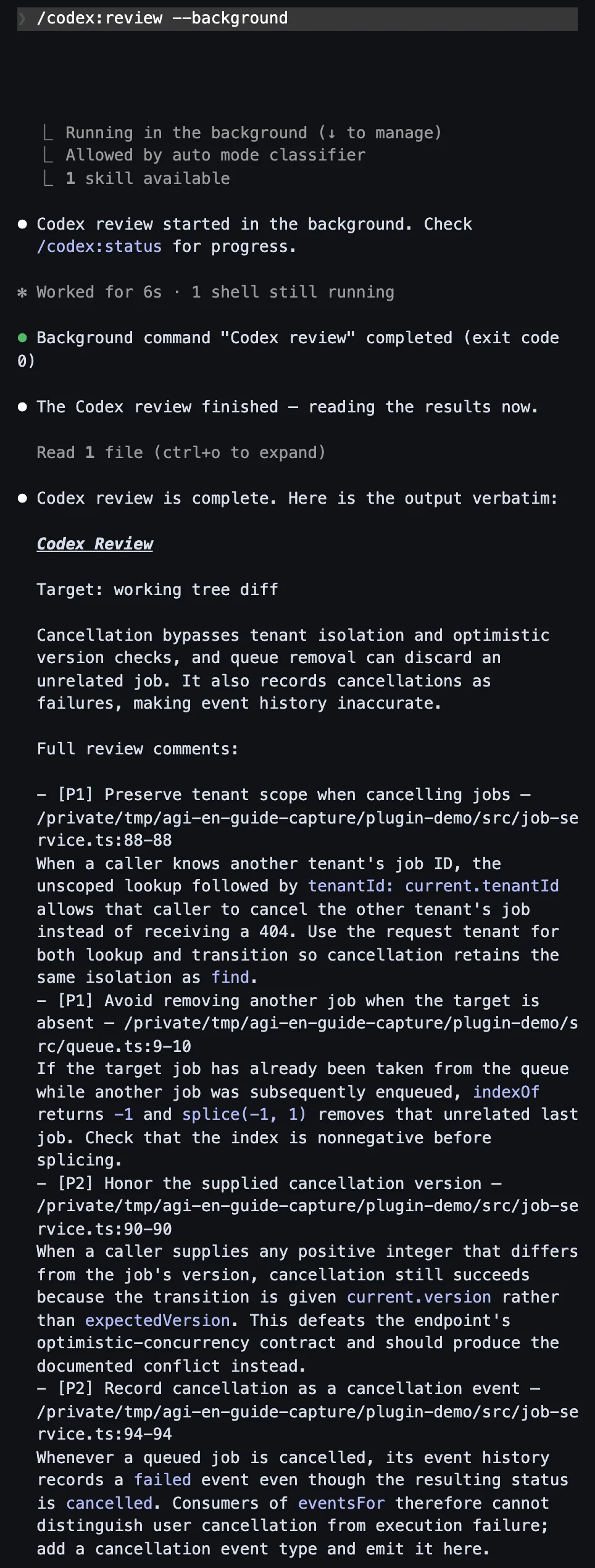
The plugin doesn't bundle its own Codex — it drives the Codex CLI, login, and settings already on your machine, and the review consumes your Codex plan's usage. There is also a review gate (/codex:setup --enable-review-gate) that makes Codex review changes before Claude Code finishes. The plugin's own README warns this can turn into long Claude/Codex loops that burn through usage limits, so keep the gate off by default and enable it only for changes you're about to ship.
For a stricter, fully isolated review, skip the shared session entirely: commit the implementation to a branch and review it from a separate worktree.
git switch -c feature/cancel-job
git add src test
git commit -m "Implement queued job cancellation"
git worktree add ../project-review main
cd ../project-review
codex
Give the reviewer three things: the diff against the base branch, the acceptance criteria, and the test results. Do not paste in the implementer's chat log — a reviewer that reads the author's reasoning inherits the author's assumptions, which defeats the point of a second vendor.
The direction also reverses cleanly: let Codex implement and Claude Code review. The mechanics are the same; the rule about independence is the same.
Pattern 2: Let one agent plan, the other build
For changes where a wrong move is expensive — migrations, auth, anything touching money — separate investigation from implementation.
Ask one agent for a read-only report:
Do not modify the repository. Report:
1. The current code path for <feature>
2. Which files a change would touch
3. Invariants that could break
4. Tests that are missing
5. Anything you could not confirm
Read the plan yourself, then hand the approved plan to the other agent to implement.
In our July 2026 test, the two agents planned very differently from the same repo: Claude Code returned a concise, current-code-anchored plan in under 3 minutes; Codex took over 7 minutes but surfaced rollback and consistency concerns the shorter plan skipped. Combining both perspectives produced a stronger pre-implementation checklist than either alone — which is the practical argument for having two planners available.
Pattern 3: Split independent tasks across worktrees
To run both agents at full speed in one repository, give each task its own worktree and branch:
git worktree add ../project-auth -b feature/auth
git worktree add ../project-search -b feature/search
Then, for example, Claude Code takes auth in one terminal, Codex takes search in another. The one hard rule: never point two agents at the same writable working tree at the same time. Simultaneous edits lose changes and corrupt test runs mid-execution.
Each vendor also ships its own isolation for parallel work within its product — Claude Code has a --worktree flag and its Agent View moves background sessions into isolated worktrees under .claude/worktrees/ before they edit anything; the ChatGPT desktop app can run Codex chats in dedicated worktrees. Those are useful, but they only manage that vendor's own sessions. The plain git worktree pattern above is the one that works across vendors.
Worktrees prevent overwrites; they don't prevent merge conflicts. Split tasks by files and completion criteria, not just by branch name.
What we verified — and what we didn't
The performance claims in this guide come from one controlled test, and we want its boundaries to be clear.
Environment: July 26, 2026, macOS, Claude Code 2.1.220 (Claude Fable 5) and Codex CLI 0.145.0 (GPT-5.6 Sol, high reasoning), same baseline commit copied into separate directories, equivalent instructions, external MCP servers disabled, writes restricted to the repo.
| Test | Claude Code | Codex |
|---|---|---|
| Multi-file implementation | 5 files, +158/−4; all public and hidden tests passed | 5 files, +251/−4; all public and hidden tests passed |
| Review of 5 planted bugs | Found 5/5, plus 1 real issue outside the diff | Found 5/5 |
| Isolated cross-review | No regressions found in the other's diff | No regressions found in the other's diff |
We re-ran the review scenario in English on July 31, 2026, on the same repository state, to capture the terminals below; both agents again reported the planted cross-tenant cancellation bug as their top finding.
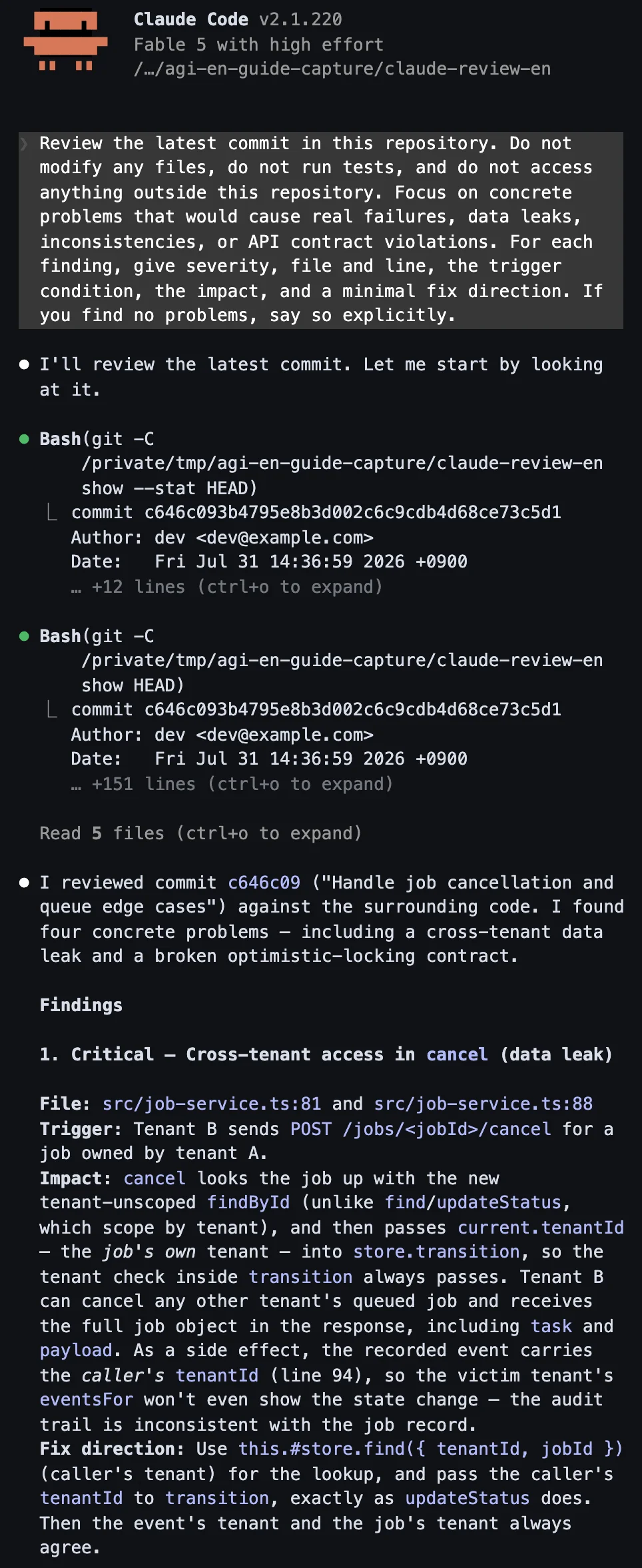
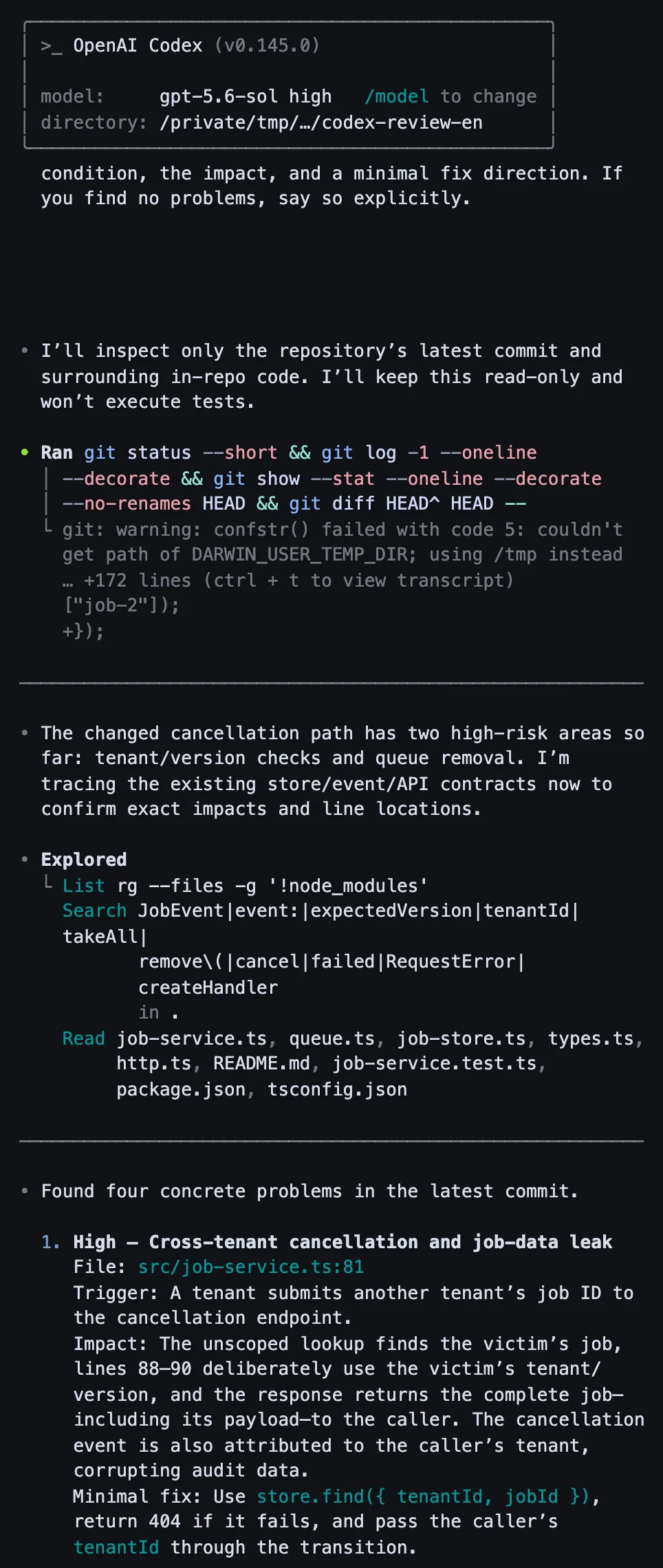
What this is not: a benchmark. Each scenario ran once; approval settings ended up unequal (Claude Code's test-run command was denied by the sandbox, Codex's was allowed), so we don't rank the two on speed; models and CLIs on both sides update fast. Everything else in this guide — pricing, plan packaging, tool status — is confirmation against official primary sources as of July 31, 2026, not our own measurement.
Common mistakes when combining two coding agents
Writing to one tree from two agents. The most common and most destructive mistake. Split by worktree, or run strictly one-at-a-time in a shared tree.
Comparing with asymmetric settings. If one agent gets higher reasoning effort, wider permissions, or extra MCP servers, you'll misread configuration differences as product differences. Record model, reasoning level, permissions, and rule files for both.
Feeding the reviewer the implementer's conclusions. Anchoring the second agent on the first one's reasoning recreates the same blind spots. Independent review first, reconciliation second.
Treating longer output as better output. A longer plan or review isn't a more correct one. Judge diffs against requirements, reproducible evidence, and failing tests.
Ignoring usage limits and your own review bandwidth. Every parallel session consumes plan usage, and every finished task lands in your review queue. Start with two concurrent tasks and only scale when nothing sits waiting on you.
Data and permissions: two vendors will see your code
Running both agents means prompts, selected code, and tool results flow to two companies instead of one. Before wiring anything together:
- Check the data controls on each plan. Consumer plans on both sides have settings that govern whether conversations may be used for model improvement; business and enterprise contracts generally exclude training by default. See Claude Code's data usage doc and OpenAI's data control documentation for your plan.
- The Codex plugin's reviews send the code under review to OpenAI, and its transfer command sends Claude Code session history to Codex. If a repo can't be shared with both vendors, don't install the bridge there.
- Apply the same safety defaults to both agents: no writes outside the repository, network access only where needed, keep
.envfiles and customer data out of context, require human approval for push/deploy/delete, and vet MCP servers before granting them anything.
One policy note if you build tooling around these agents: Anthropic's terms don't permit third-party products to route requests through your subscription credentials, and the rules in this area shifted more than once during 2026. Check the current terms before depending on any third-party quota arrangement.
When tasks pile up: supervising both agents in one place
One Claude Code task and one Codex task fit comfortably in two terminals. The pain starts at three or four concurrent tasks, when you're touring windows to find out which agent is waiting on you — babysitting, as practitioners call it.
The official surfaces don't solve this across vendors: Claude Code's Agent View (claude agents) lists Claude sessions only, and the ChatGPT app shows Codex only. Cross-vendor supervision needs a third-party surface. Honest options as of July 31, 2026:
| Tool | Best fit | Cost / notes |
|---|---|---|
| T3 Code | Free OSS desktop + mobile apps for Claude Code, Codex, Cursor, OpenCode, Grok Build | MIT; very active; bring your own subscriptions |
| Paseo | Free OSS with desktop, native mobile, and web clients; long agent adapter list | AGPL-3.0; active |
| Conductor | Mac-native parallel workspaces with a PR-centric flow (Claude Code, Codex, Cursor, OpenCode) | Free locally; $50/mo cloud tier; macOS only |
| Codeman | Self-hosted web mission control with phone access via tunnel (Claude Code, Codex, OpenCode, Gemini CLI) | MIT; self-hosted |
| AGI Cockpit | A multi-agent work OS: coding and non-coding tasks, choice-based approvals, diffs and previews, supervision from your phone | Local features free and unlimited; membership $20/mo adds Autorun and remote access |
Two cautions from our source check: Vibe Kanban, widely recommended in 2025 posts, now carries a "sunsetting" banner on its repository with no main-branch activity since April 2026 — evaluate it as dormant software, not a maintained option. And Block's Buzz is a different category — a shared workspace where humans and agents collaborate as a team, not a session manager for your own machine.
Disclosure: AGI Cockpit is our product, so weigh this paragraph accordingly. Cockpit runs Claude Code, Codex, Cursor, Grok Build, Antigravity, and its own Cockpit Agent side by side on Windows, macOS (Apple Silicon), and Linux. Tasks sit on one board as running, waiting for you, or done; decisions come to you as Asks — questions with tappable choices — rather than a terminal prompt you have to find; and the same view covers non-coding work like research or content tasks. Every local feature is free and unlimited with no account. A membership ($20/mo or $200/yr) adds exactly two things: Autorun scheduling and remote access, so you can check tasks and approve Asks from your phone. Your Claude and ChatGPT subscriptions remain separate costs. If you only run one vendor's agent, or a free OSS manager already covers you, you don't need Cockpit.
During the July 31 English re-run we drove a Claude Code review task and a Codex test task against the same verification repo from one Cockpit board — the screenshots below are those real tasks, not a staged demo:
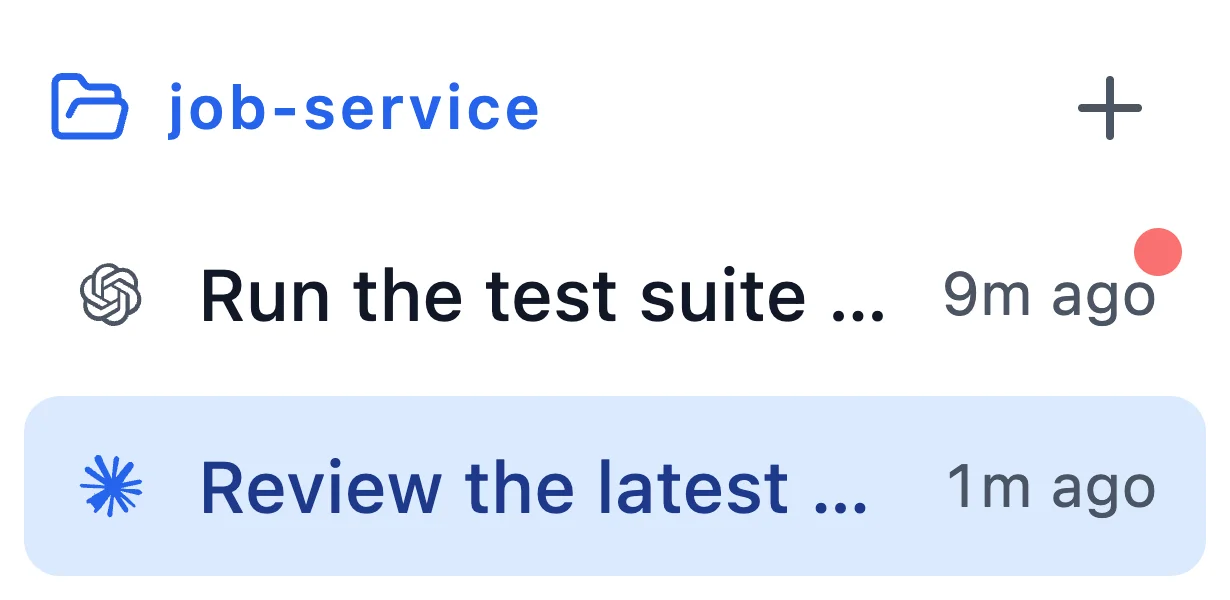
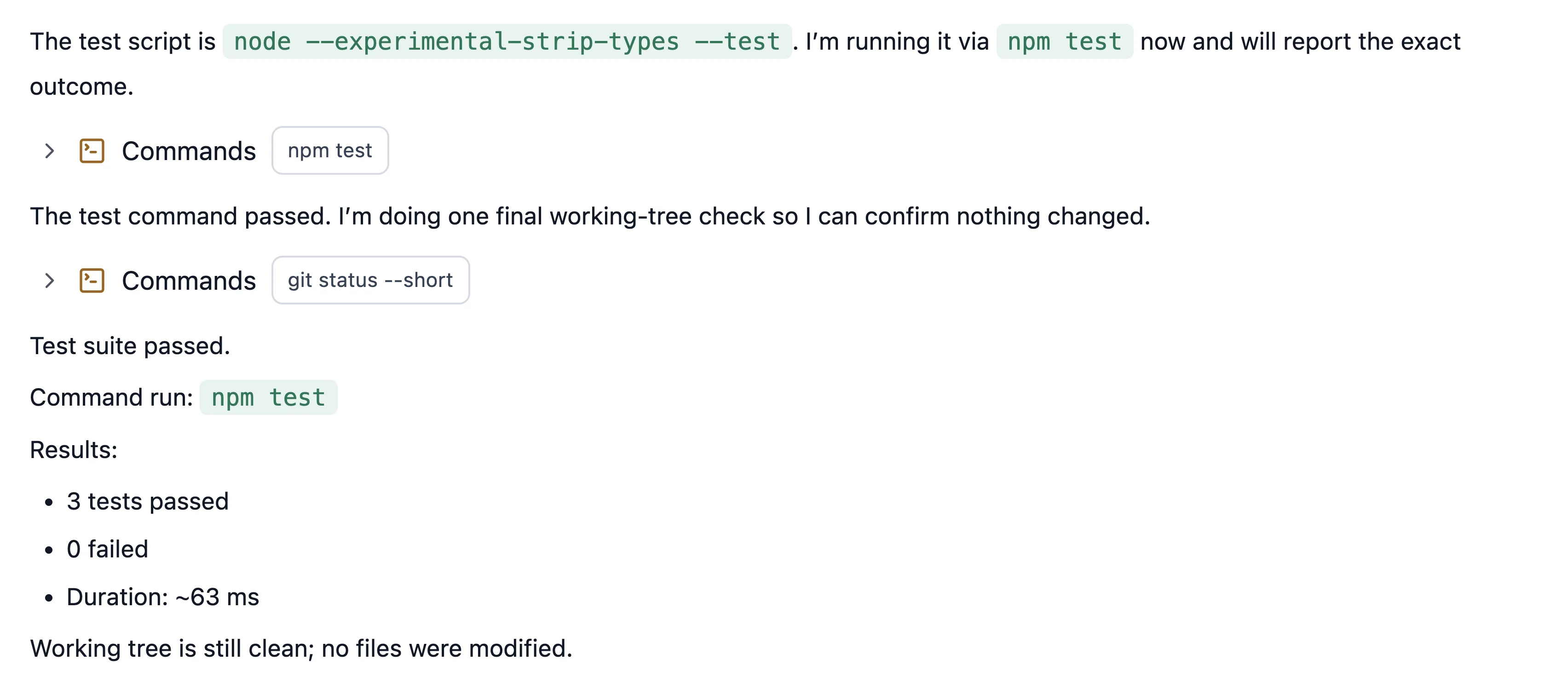
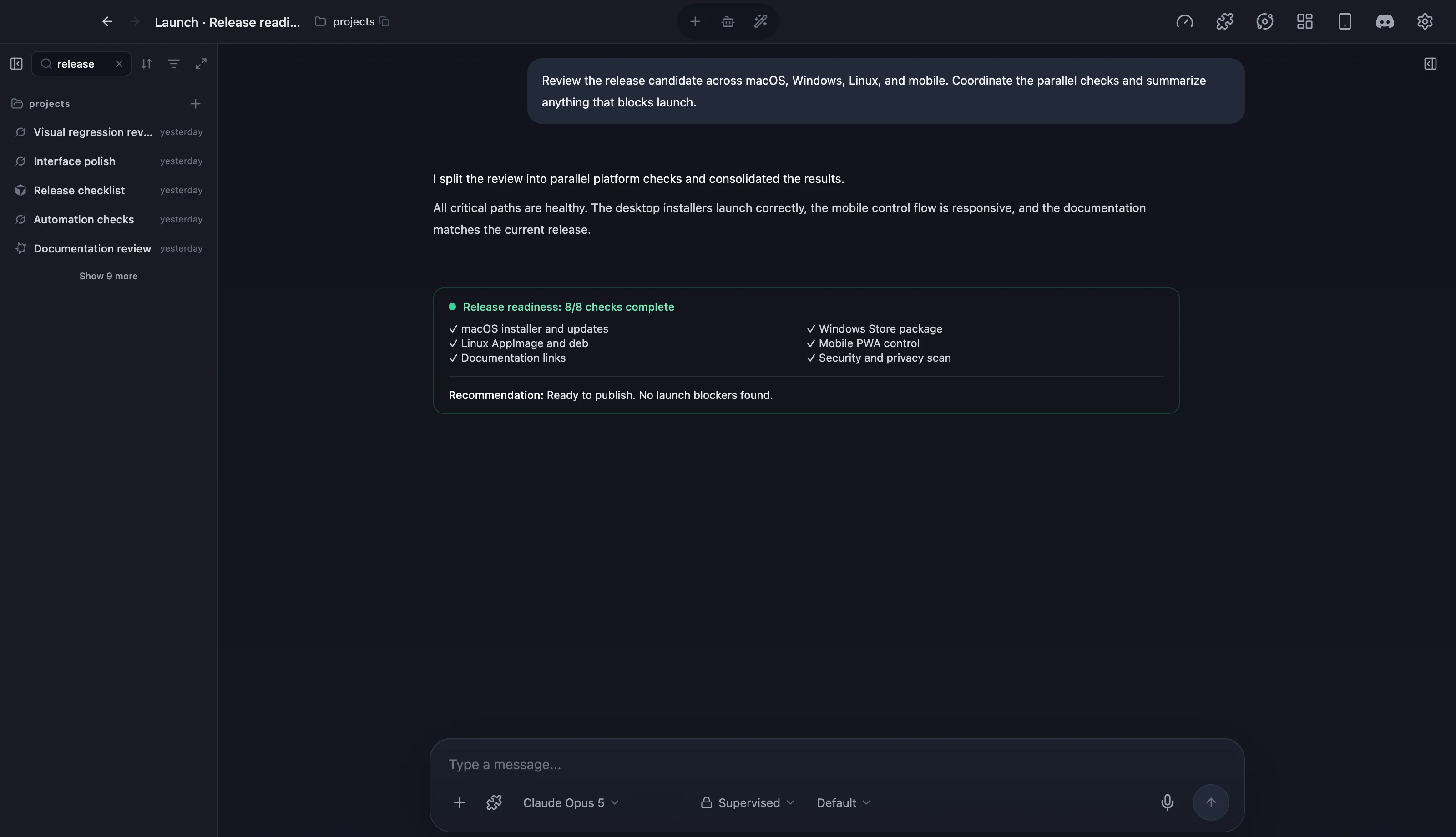
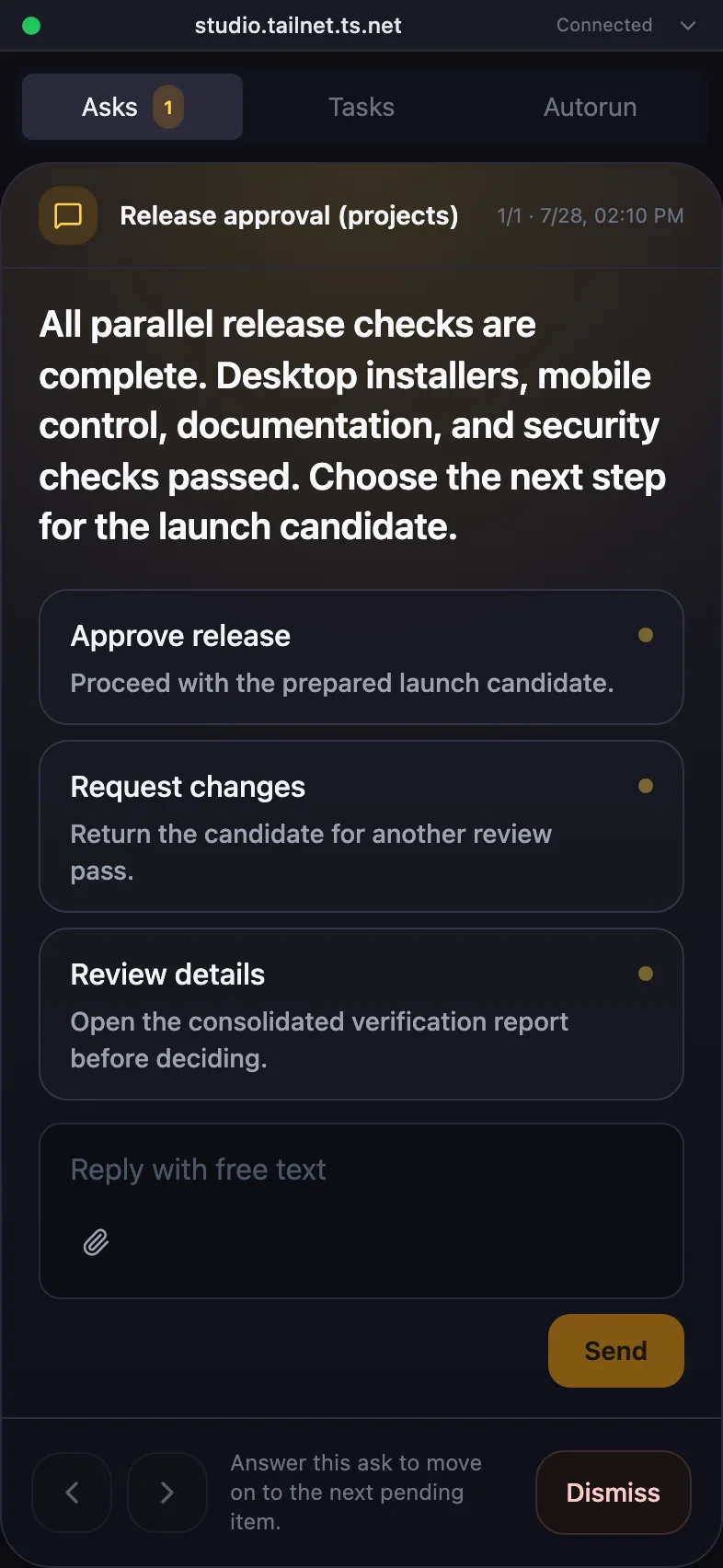
Whichever tool you pick, apply the same test we recommend for everything in this guide: run two real tasks through it and check whether files stayed isolated, whether you noticed the waiting states, and whether review-and-merge actually got faster. Pick the tool that improves those three things for you.
Who doesn't need this setup
- You're happy with one agent. The official single-vendor experience is simpler and cheaper. Come back when you want independent review.
- Your organization can't send code to two vendors. The cross-review patterns are off the table; single-vendor parallelism still works.
- You haven't yet built a review habit for agent output. Two agents produce twice the output to review. Get one agent's workflow solid first.
- Your projects are small and occasional. The setup cost outweighs the benefit below a few tasks per week.
FAQ
Is there an official integration between Claude Code and Codex?
Partially. OpenAI publishes an official Codex plugin for Claude Code that runs Codex reviews and task delegation from inside a Claude Code session. There is no joint guidance from both vendors on combined use; the closest thing to a shared standard is AGENTS.md, which Codex reads natively and Claude Code can import via CLAUDE.md.
Can Claude Code and Codex work in the same repository?
Yes. The same repo is fine — the same writable working tree at the same time is not. Run them sequentially in one tree, or in parallel across git worktree checkouts.
Do CLAUDE.md and AGENTS.md conflict?
No. Keep your rules in AGENTS.md and have CLAUDE.md import it (@AGENTS.md) or symlink to it. Both agents then read the same instructions, per each vendor's own documentation.
Does running both double my AI costs?
It doubles subscriptions, not necessarily spend: two $20 plans (Claude Pro + ChatGPT Plus) cover everything in this guide. Codex can also run pay-per-token with an API key. The real cost to watch is usage limits — reviews, gates, and parallel sessions all draw from each plan — plus your own time reviewing more output.
Can I supervise both agents from my phone?
Each vendor offers mobile access to its own agent (Claude's remote and dispatch features; Codex in the ChatGPT app). For both in one view, you need a cross-vendor tool: T3 Code and Paseo ship free mobile apps, and AGI Cockpit's membership adds remote phone access with approval prompts.
Which one should I subscribe to first?
Whichever matches how you work: Claude Code for interactive, conversation-driven development; Codex for delegating well-defined tasks and reviewing results. In our controlled test both implemented and reviewed correctly — so pick by working style, then add the second vendor when independent review starts paying for itself.
Primary sources
All accessed July 31, 2026.
- OpenAI: Codex plugin for Claude Code
- Anthropic: Claude Code memory — CLAUDE.md and AGENTS.md
- OpenAI: How Codex reads AGENTS.md
- AGENTS.md — the open cross-agent standard
- Anthropic: Agent View / worktrees / Desktop
- OpenAI: Codex CLI (open source) / cloud tasks / pricing
- Anthropic: pricing / data usage / legal and compliance
- Git: git-worktree
- AGI Cockpit